How to Reduce RTO in Ecommerce India: A Practical Guide
RTO drops when you fix address quality, confirm COD orders before dispatch, and route shipments through couriers that actually deliver in a given pincode. Most brands focus on the return rate percentage and miss the full per-order cost — which, once you add forward freight, reverse freight, and repackaging, routinely exceeds the product margin on a mid-ticket item.
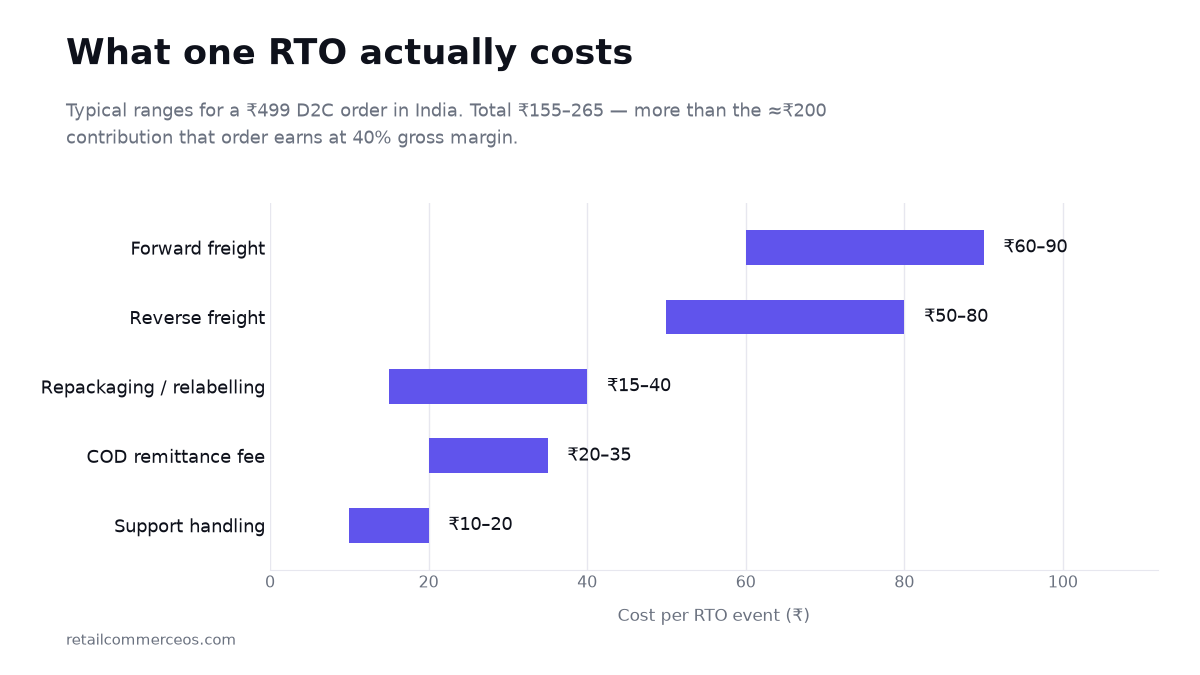
What RTO actually costs per order
Most P&Ls show RTO as a line called "returns." That number hides the real damage.
Take a ₹499 order — a common price point for personal-care or homeware D2C brands. Here is what a single RTO event costs:
| Cost component | Typical range (₹) |
|---|---|
| Forward freight | 60–90 |
| Reverse freight | 50–80 |
| Repackaging / relabelling | 15–40 |
| Customer support handling | 10–20 |
| COD remittance fee (if order was COD) | 20–35 |
| Working capital lock-up (notional) | varies |
| Total direct cost per RTO | 155–265 |
On a ₹499 order with a 40% gross margin, your contribution before shipping is around ₹200. A single RTO event wipes that contribution and adds a loss on top. At a 25–30% RTO rate — normal for COD-heavy catalogs in tier-2 and tier-3 cities — a meaningful share of your total orders are not just zero-margin; they are actively destroying cash.
The reverse freight figure is often underestimated because brands pay it on a credit note they see weeks later. The real-time P&L looks better than reality.
Why RTO happens: the four root causes
1. COD as default payment
India's COD share in D2C ecommerce remains high, especially outside the eight large metros. A buyer placing a COD order has zero financial commitment at the time of order. Impulse orders, duplicate orders (same buyer ordering from two brands to compare), and "maybe I'll buy it if it arrives" orders all funnel through COD. The act of paying is deferred to the doorstep, and a non-trivial share of buyers decide "no" at that moment.
2. Address quality
Indian addresses are structurally messy. Pincode and city mismatches, missing landmarks, wrong flat numbers, and locality names that exist under three different spellings all cause delivery failures. The courier makes one or two attempts, marks the shipment as "undeliverable," and it comes back. The buyer often did want the product — the address just did not work.
3. Delivery attempt failure and NDR handling
Most couriers allow two or three delivery attempts. If the buyer is not home, or the courier partner does not call ahead, the shipment fails. What happens next — the NDR (Non-Delivery Report) workflow — determines whether the shipment gets a genuine re-attempt or quietly becomes a return. Many brands have no NDR process at all. The courier calls the brand's ops team once, gets no useful instruction, and the shipment is returned.
4. Buyer's remorse and intent mismatch
Some orders are placed with low intent. Deep-discount campaigns, aggressive retargeting, and checkout UX that removes friction all increase order volume, but the incremental orders carry higher RTO rates. A buyer who checked out after a 70% off pop-up on their third retargeted visit is a different risk profile from a buyer who found you through a search query and chose a product deliberately.
Lever 1: Address verification before dispatch
Run the delivery address through a pincode serviceability check before you push the order to the courier. This sounds obvious but many brands skip it, especially when orders come in overnight.
More importantly, add a phone-number level check for COD orders. If the mobile number has been associated with previous RTO events across the courier's network, that is a signal. Most courier APIs surface this as a "customer risk score" or equivalent. Use it to hold orders for manual review rather than auto-dispatching.
For address fields specifically: enforce pincode-to-city validation at checkout. If a buyer types a Bengaluru pincode and a Chennai city name, flag it before the order is confirmed. A small friction point here prevents a large cost point later.
Lever 2: COD confirmation before dispatch
Call or WhatsApp the buyer within two hours of a COD order being placed to confirm. This single step is the highest-ROI intervention in the RTO playbook.
The mechanics: a short message or call that confirms the order, delivery estimate, and address. Buyers who placed a genuine order confirm quickly. Buyers who placed an impulse order often do not respond, or use this moment to cancel. A cancellation before dispatch costs you nothing except the opportunity. An RTO after dispatch costs you ₹155–265 as shown above.
Some brands convert this confirmation step into a prepaid nudge — "confirm your order and switch to prepaid to get free shipping." That nudge works best on buyers who are already engaged (they respond to the confirmation message) and reduces both RTO risk and COD fee cost simultaneously.
Lever 3: Prepaid conversion incentives
Every COD order converted to prepaid removes the RTO risk almost entirely (prepaid RTO rates are typically 3–6% versus 20–35% for COD). The mechanisms that work:
- Checkout nudge: Show the COD fee explicitly (₹25–40) and offer free shipping for prepaid. Make the cost differential visible, not buried in a tooltip.
- Post-order SMS/WhatsApp: "Pay now and save ₹30 on your order" with a direct payment link. This works because the buyer has already committed mentally — they just placed the order.
- Repeat buyer incentives: Buyers who have received previous orders without RTO are lower risk. Offer them prepaid-exclusive early access or discounts.
The goal is not to eliminate COD — it genuinely serves buyers who do not have or trust digital payments. The goal is to shift the marginal COD buyer, who had a prepaid option and chose COD out of habit, toward prepaid.
Lever 4: Courier selection by pincode-level performance
A courier that delivers reliably in Mumbai Andheri West may have a 40% failure rate in a tier-3 UP pincode. Aggregate courier scorecards hide this. What matters is delivery performance at the pincode level for the specific pincodes your orders go to.
Pull a 30-day report: for each courier you use, what is the first-attempt delivery rate and the RTO rate, broken down by pincode or at least by tier (metro / tier-2 / tier-3)? Route future orders from high-RTO pincodes to the courier with the best performance there, not to the cheapest rate overall.
This requires some manual work if you are managing courier allocation in a spreadsheet. Platforms that surface per-pincode courier performance make this automatic, but the underlying logic is the same whether you do it manually or systematically.
Lever 5: NDR follow-up within 24 hours
When a delivery attempt fails, you have a narrow window to save the shipment. Most couriers hold the package for 3–5 days before initiating the return. Within that window, a WhatsApp or IVR message to the buyer — "our courier tried to deliver today, confirm your address or reschedule" — recovers a meaningful share of NDR shipments.
The message should include the courier tracking link, the consignment number, and a one-tap option to confirm availability. Keep it short. Buyers who respond and confirm a reschedule convert at high rates. Buyers who do not respond after 48 hours are unlikely to accept, and initiating the return early saves you an additional day's holding fee.
NDR follow-up is often owned by no one in early-stage D2C brands. Assign it explicitly — either to a tool or to a person checking a queue daily.
Putting the arithmetic together
If your current RTO rate is 28% on 1,000 COD orders a month, you are absorbing roughly 280 RTO events. At ₹200 average cost per RTO, that is ₹56,000 in direct monthly loss from RTOs alone, before you count the margin you did not earn.
Dropping that rate to 18% — realistic with address verification, COD confirmation, and NDR follow-up in place — reduces RTOs to 180, saving ₹20,000 a month. At scale, the number becomes the difference between a viable unit economics model and one that requires constant fundraising to cover ops losses.
Retail Commerce OS scores customers on their return and cancellation history, so repeat offenders can be held for confirmation instead of auto-dispatched, and reports contribution margin alongside gross profit so the cost side is visible in the same place as the orders. But the levers above work regardless of what stack you run — the arithmetic is the same.
If you are looking at your RTO rate and wondering where to start, COD confirmation calling is the fastest thing you can implement this week. Everything else — pincode routing, address validation, NDR automation — layers on top of a confirmation workflow that already exists.